

Omaha Poker, with its unique four-hole card rule, offers players a more complex and thrilling experience compared to Texas Hold’em. Many players transitioning from Texas Hold’em to Omaha often find themselves in tricky situations after the flop, even with seemingly strong starting hands. This isn’t just bad luck; it’s a reflection of Omaha poker’s deeper strategies, where a core concept known as the “wrap” plays a crucial role.
A wrap is not just another draw; it’s a cornerstone of aggressive Omaha strategy. It’s why drawing hands in this game can sometimes be favored over already-made hands. Understanding and mastering the wrap is essential for anyone looking to level up their Omaha Poker skills. This article will delve into the intricacies of the wrap, helping you make more informed decisions at the poker table.
What is a “Wrap” in Omaha Poker?
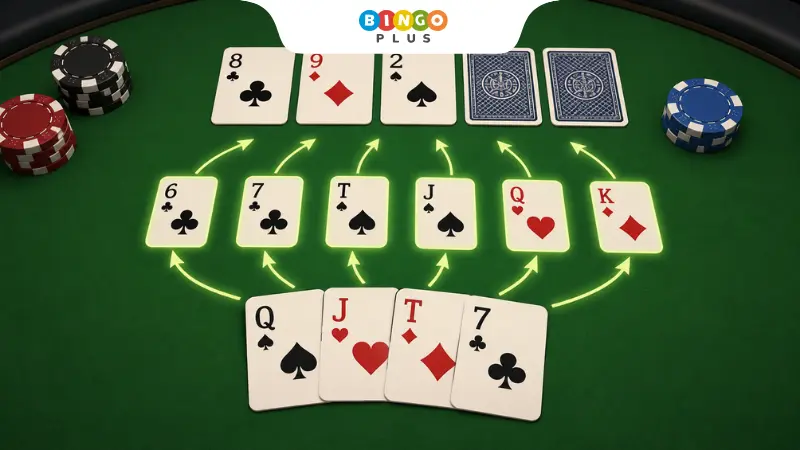
In Omaha poker, a wrap refers to a special type of straight draw that utilizes all four of your hole cards in conjunction with the community cards to create multiple straight possibilities. Unlike Texas Hold’em, where you typically have only one or two ways to complete a straight, a wrap covers a much wider range of card ranks, significantly increasing your chances of hitting a straight.
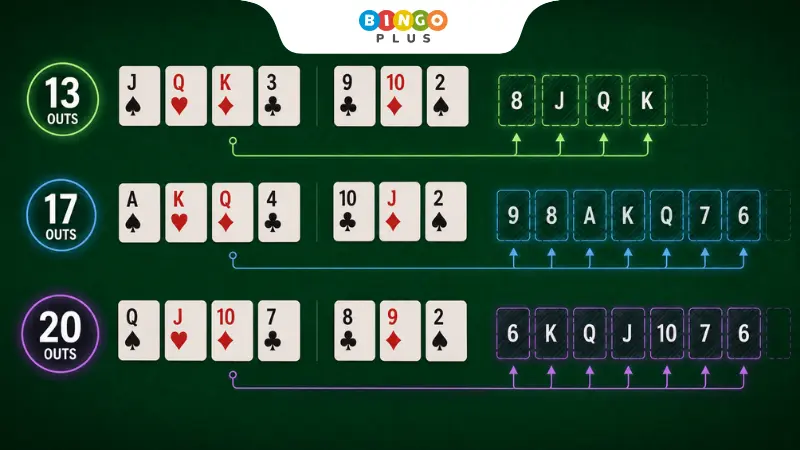
Simply put, when your hole cards can “surround” the community cards, forming a continuous range of ranks where several different cards can complete a straight, you have a wrap. The power of this draw lies in its potential number of “outs,” which far exceeds ordinary draws, sometimes reaching 13, 17, or even an astonishing 20 outs. In Omaha, draws with a high number of outs are not weak; they are powerful “weapons” that can turn the tide of the game.
The Anatomy of a Wrap: How It Forms
To understand wraps, it’s crucial to observe how your four hole cards interact with the community cards. A wrap forms when your hole cards and the board create a “surrounding” structure, generating multiple straight possibilities. The stronger the connectivity between your hole cards, the more outs you generate. Let’s break down the different types of wraps.
The 13-Out Wrap
This is the entry-level wrap, yet its strength already surpasses most Texas Hold’em draws. It typically occurs when your hole cards and the community cards form a relatively tight straight range.
Example Structure:
- Board: 9♦ T♣ 2♠
- Your Hand: J♠ Q♦ K♥ X (X represents any card)
In this scenario, cards like 8, J, Q, or K could complete your straight, depending on the specific combinations. Even with this “entry-level” wrap, you might find yourself in a near coin-flip situation against already-made hands.
The 17-Out Wrap
With better connectivity in your hand, your number of outs expands significantly. This means you cover more cards in the deck, dramatically increasing your probability of hitting a straight by the turn or river. A 17-out wrap often puts you ahead of strong hands like a “Top Set,” even if it doesn’t always feel that way.
The 20-Out Wrap (The Monster)
The 20-out wrap is the dream scenario in Omaha Poker. In this situation, you have so many combinations to hit your straight that you are actually favored against most strong made hands. This is an incredibly powerful draw that gives you significant “pot equity” after the flop.
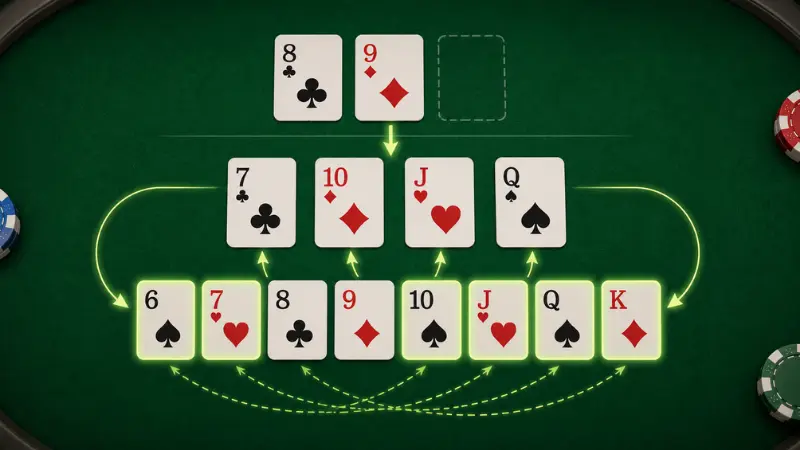
Classic 20-Out Wrap Explained:
Imagine this setup:
- Board: 8♣ 9♦ X (X represents any card)
- Your Hand: Q♠ J♥ T♦ 7♣
Your hand perfectly “wraps” around the community cards. You have connectivity on both sides, with no gaps. Any card from 6 to King (excluding duplicates already on the board) can complete your straight. Let’s break down these outs:
- Kings: 4 outs
- Queens: 3 outs
- Jacks: 3 outs
- Tens: 3 outs
- Sevens: 3 outs
- Sixes: 4 outs
That’s a total of 20 outs. More importantly, many of these outs will give you the “nut straight,” not just any straight. This distinction is paramount in Omaha poker, as it often determines whether you win a big pot or lose one.
Wrap Equity: Why Draws Can Become Favorites
The power of a wrap lies in its mathematical advantage. Let’s look at the “equity” performance of different wrap types:
| Draw Type | Number of Outs | Flop to Turn Equity | Flop to River Equity |
|---|---|---|---|
| Standard OESD | 8 | 17.8% | 32.7% |
| Small Wrap | 13 | 28.9% | 49.9% |
| Big Wrap | 17 | 37.8% | 61.8% |
| Monster Wrap | 20 | 44.4% | 69.7% |
As the table shows, a “Monster Wrap” with 20 outs has nearly a 70% chance of completing by the river. This means if your opponent holds a set and you have a monster wrap, you are actually ahead. In Omaha poker, powerful wraps give you ample reason to act aggressively early in the hand and fight for the pot.
Nut Outs vs. Non-Nut Outs: The Critical Distinction
A common mistake beginners make in Omaha poker is treating all outs equally. However, there’s a critical distinction between outs, especially in a game where the “second-best hand loses big pots.”
What are nut outs?
Nut outs are cards that will give you the best possible hand on the board (typically the nut straight). Non-nut outs, while still completing a straight, might not be the highest possible straight, making them vulnerable to bigger straights.
Why This Matters
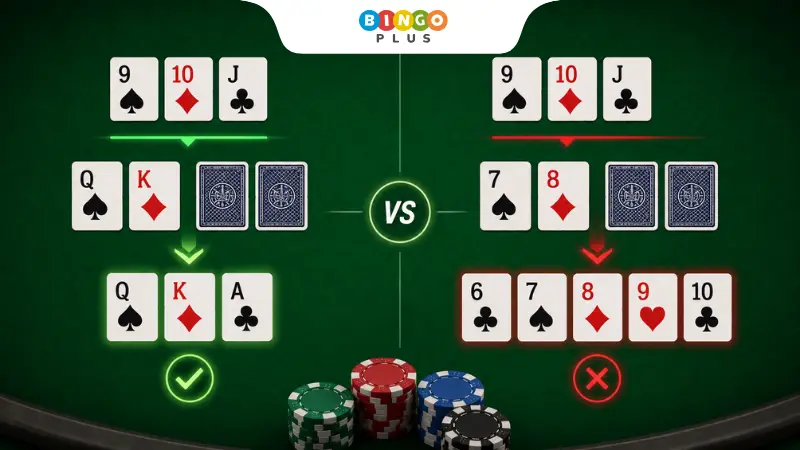
In Omaha poker, holding the second-best hand often leads to losing significant pots. For instance, consider the following example:
Hand A: Q♠ K♦ X X
Hand B: 7♠ 8♦ X X
Both hands have straight draws. However, only Hand A consistently hits the top end of the straight (Q-K). If Hand B hits its straight (7-8), it forms a lower straight, often referred to as the “Idiot End” in Omaha, which is highly susceptible to being beaten by a larger straight. Therefore, when evaluating wraps, prioritizing outs that lead to the nut straight is crucial. If most of your outs don’t give you the best possible hand, your wrap’s strength is far less than it appears.
Playing Wraps Aggressively (And Why You Should)
Treating wraps as passive draws is a significant mistake in Omaha Poker. When you hold a powerful wrap, you should adopt an aggressive strategy for several reasons:
The Power of the Semi-Bluff
With 17 or 20 outs, your hand possesses immense equity. This allows you to take aggressive actions after the flop:
- Bet aggressively
- Raise instead of just calling
- Even shove all-in in the right situations
Why? Because you can win the pot in two ways:
- Fold Equity: Your aggressive action might force your opponents to fold their hands, even if they are currently ahead.
- Hit Your Draw and Win at Showdown: If your opponents call, you still have a high probability of hitting your draw on subsequent streets and winning the pot.
When to Commit Fully
If you flop a “monster wrap,” especially on a relatively “dry board” (a board with few drawing possibilities), your objective is straightforward: get all your chips into the pot early. You shouldn’t wait for the turn, because on the turn:
- The board might pair, diminishing the value of your straight outs.
- Flushed draws could be completed, making your stake less valuable.
- The board texture might change, reducing your equity.
Acting aggressively when your wrap is strongest maximizes your edge. Omaha Poker often punishes hesitant play.
The Flush Block Problem: When Wraps Lose Value
Not all wraps are created equal. One of the biggest dangers in Omaha poker comes from “two-toned boards” (boards with two cards of the same suit).
What Happens on Wet Boards
If the community cards show two cards of the same suit, and you don’t hold a flush draw, your wrap becomes vulnerable. You might hit your straight, but still lose to an opponent’s flush. This scenario is very common in Omaha, so it’s crucial to consider the board’s suit structure when evaluating your wrap.
The Professional Approach
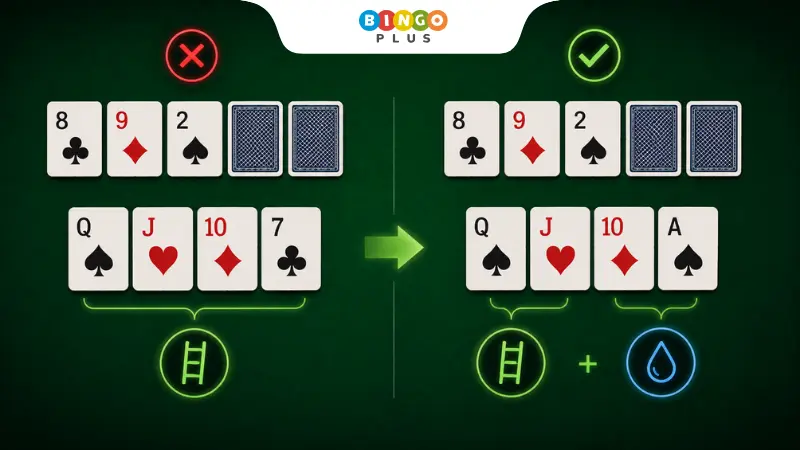
Experienced players actively seek “Coordinated Wraps” – combinations that include both a straight draw and a flush draw. Ideally, this would be a “nut flush draw.” This combination provides you with multiple ways to win and offers protection against unfavorable runouts.
- “Naked Wrap“: A straight draw only, without any accompanying draws.
- “Premium Wrap“: A straight draw combined with a flush draw (or other strong draws).
There’s a massive difference in value between these two. Naked wraps demand caution, while premium wraps invite aggression.
Evaluating the Turn: When the Math Changes
Wraps are typically strongest on the flop. However, if you miss your draw on the turn, the situation changes significantly.
Why Equity Drops
From the flop to the turn, you have two cards (turn and river) to come. But by the turn, you only have one card (the river) left. This drastically reduces your chances of hitting your draw. Furthermore, if the turn card:
- Pairs the board
- Completes a flush
- Changes the board texture
Your draw might not just weaken; it could become completely “dead,” meaning no river card can help you win. Omaha poker is unforgiving to stubborn play.
Adjusting Your Strategy
Don’t blindly continue just because you had a strong draw on the flop. On the turn, you need to re-evaluate the following:
- Are your outs still “clean“? Meaning, will they give you the nut in hand if you hit?
- Can you still hit the nuts?
- Is your opponent now representing a stronger hand?
Flexible strategy adjustment is a key to success in Omaha Poker.
Dry vs. Wet Boards: Understanding Board Texture
In Omaha poker, the board texture significantly impacts the strength and playability of your wrap.
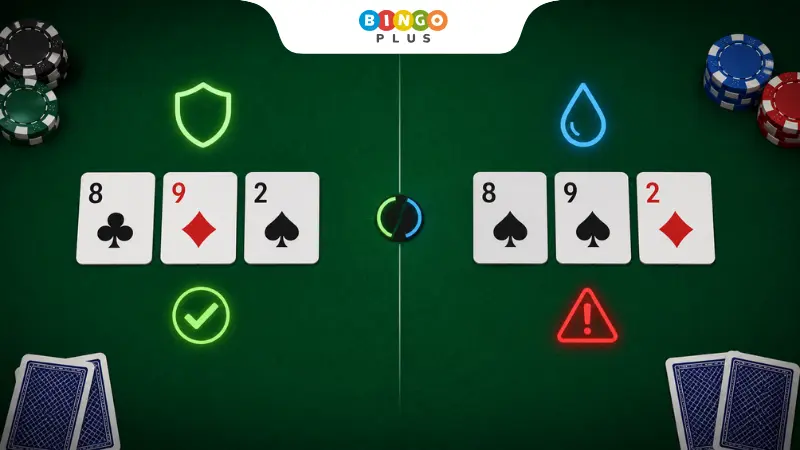
Dry Boards
Example: 8♣ 9♦ 2♠ (a rainbow board, meaning three different suits)
On such a board, your wrap-outs are “clean.” When you hit your straight, you are very likely to win the pot. Aggressive play makes sense here, as you don’t have to worry about the threats of flushes or full houses.
Wet Boards
Example: 8♠ 9♠ 2♦
Here, a flush draw is present on the board. If you don’t hold cards of that suit, your straight outs might be “tainted“; you could complete your straight but still lose to an opponent’s flush. Therefore, on wet boards, even with a strong wrap, you need to assess the risks more carefully.
Key Insight
The strength of your wrap isn’t solely about the number of outs. It’s equally about how “clean” those outs are—whether they will give you the nut hand and if they are vulnerable to other stronger hand types.
The Redraw Factor: Thinking Beyond the First Hit
Advanced Omaha players don’t just stop at hitting their primary hand. They think further ahead about how the hand might develop after their initial hit.
What is a Redraw?
A redraw refers to your ability to improve your hand even after hitting your main draw. For example:
- You hit a straight, but you also have a flush draw.
- If the board pairs or another card comes, you still have backup ways to improve your hand, potentially forming an even stronger one.
Why Redraws are Important
In large Omaha pots, a single strong hand might not always be enough to win. Redraws provide you with “insurance,” giving you additional chances to win or improve your hand later in the game. In Omaha, having redraw potential often makes the difference between winning a stack and losing one.
Responsible Gaming: Enjoying Omaha Poker Safely
Omaha Poker is an exciting and strategic online poker game, but it’s crucial to remember that all online casino games involve an element of chance. No strategy, including mastering the wrap, can guarantee consistent profits. While understanding advanced concepts like wraps can improve your decision-making, it doesn’t eliminate the inherent randomness of the game.
We encourage all players to play responsibly. Before you start playing, always set a reasonable budget and stick to it. Avoid chasing losses, and always view gaming as a form of entertainment. If you need a break, you can always log out of your BingoPlus account. Remember, the ultimate goal is to enjoy the process, not solely to win money. If you feel that gaming is negatively impacting your life, please seek assistance.
Responsible Gaming: Enjoying Omaha Poker Safely
Omaha Poker is an exciting and strategic online poker game, but it’s crucial to remember that all online casino games involve an element of chance. No strategy, including mastering the wrap, can guarantee consistent profits. While understanding advanced concepts like wraps can improve your decision-making, it doesn’t eliminate the inherent randomness of the game.
We encourage all players to play responsibly. Before you start playing, always set a reasonable budget and stick to it. Avoid chasing losses, and always view gaming as a form of entertainment. If you need a break, you can always log out of your BingoPlus account. Remember, the ultimate goal is to enjoy the process, not solely to win money. If you feel that gaming is negatively impacting your life, please seek assistance.
rm of entertainment. If you need a break, you can always log out of your BingoPlus account. Remember, the ultimate goal is to enjoy the process, not solely to win money. If you feel that gaming is negatively impacting your life, please seek assistance.
Frequently Asked Questions (FAQs)
In Omaha poker, players are dealt four hole cards, while in Texas Hold’em, they receive two. In Omaha, you must use exactly two of your hole cards and three community cards to form the best five-card hand. This makes Omaha hands more complex and gives draws, like wraps, greater potential.
The “wrap” is an extremely important concept in Omaha poker because it represents powerful straight draw potential. Understanding wraps helps players accurately assess hand strength and make more aggressive decisions after the flop, significantly increasing their chances of winning.
Identifying a “Nut Wrap” means determining if the straight it can form is the highest possible straight on the board. If your wrap can form the absolute strongest straight and no other player can make a higher one, then it’s a nut wrap. Prioritizing nut wraps is key to avoiding losing big pots in Omaha.
On a wet board (where community cards suggest a possible flush draw or an already completed flush), even if you hit your straight, you might still lose to an opponent’s flush. Therefore, in such situations, you need to evaluate if your wrap also includes a flush draw (especially a nut flush draw) to increase your winning chances and security.
You can experience various poker games, including Omaha poker, at BingoPlus online casino. Log in to BingoPlus now and start your poker journey!
Conclusion
Mastering the concept of the “wrap” in Omaha Poker is a crucial step in transforming from an average player to a skilled one. It’s not just about understanding the mathematics of straight draws; it’s about accurately assessing your hand’s potential within complex board structures and taking decisive action. From identifying different types of wraps to distinguishing between nut and non-nut outs and understanding dry versus wet boards and redraw factors, every detail will influence your decisions.
By integrating these advanced strategies into your poker game, you will be able to make more confident decisions at the Omaha tables, maximize your winnings, and truly enjoy this captivating online poker game. Head over to BingoPlus today to put this knowledge into practice and experience the significant advantage that mastering the “wrap” can bring!