

Trying to guess six random numbers out of a massive 49 or 58-number pool feels like an impossible task because the human brain struggles to visualize large numerical spreads. The Delta Number System fixes this problem by compressing your selection field. Instead of forcing you to guess the actual winning numbers, it allows you to guess the mathematical distance between adjacent numbers.
Because winning lottery balls historically fall within very tight, predictable intervals, tracking these gaps lets you work with a compact pool of single and low double-digit entries (mostly between 1 and 15) that expand into an optimized, balanced ticket line.
How Delta Distance Tracking Compresses the Board
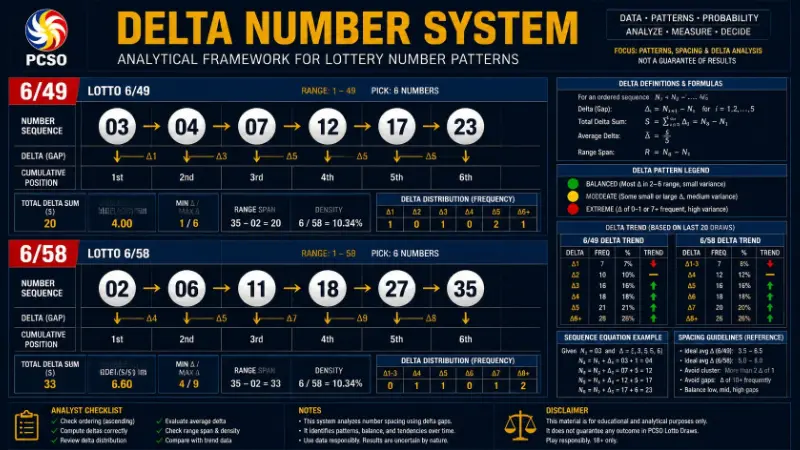
To understand why this system works, you have to look at how numbers actually fall during live drawings. Winning combinations rarely feature massive, erratic jumps across the card. Instead, adjoining number distribution proves that consecutive winning balls naturally stay close together. By focusing on Delta distance tracking, you stop looking at the absolute value of the numbers and start measuring the physical spaces between them.
When you look at a standard winning combination, the space from one ball to the next is frequently less than 15 digits. By choosing a base Delta sequence made entirely of small numbers, you are mirroring this natural clustering habit.
You are no longer guessing six distinct numbers spanning across a massive card; you are picking six tiny gap measurements that will later stretch out into a perfectly distributed ticket.
Turning Tiny Gaps into Winning Combinations
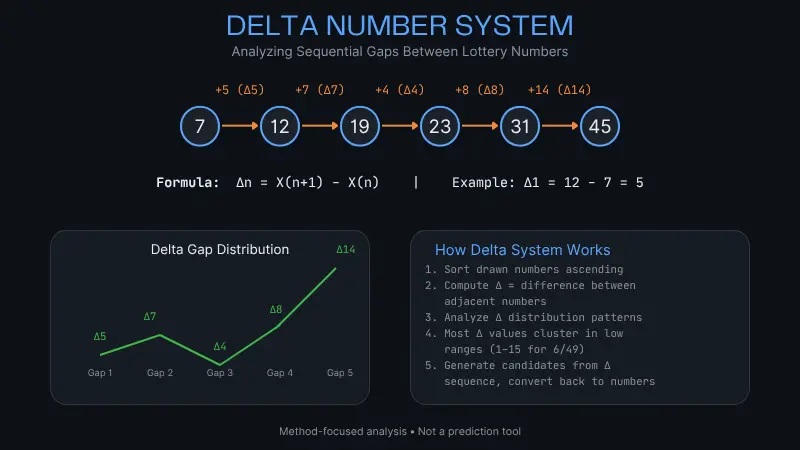
Building your raw ticket line starts with picking six small interval values to form your base Delta sequence. A standard, highly effective setup usually features three single digits, two low double digits under fifteen, and one tiny anchor number like one or two.
Once you have chosen these small intervals, you must run them through a randomized shuffle phase. If you leave them sorted strictly from smallest to largest, your final combination will cluster too tightly at the front of the card, completely breaking natural drawing habits.
After scrambling the order of your small numbers, you run them through a cumulative addition chain to generate your actual playable lotto numbers. The first number in your shuffled sequence becomes your first lottery number. To find the second, you add the second Delta value to that first number. You keep adding each consecutive gap to the running total to build out all six entries.
While doing this, always watch your numerical expansion limit. If you pick delta gaps that are too large, your addition chain will snowball quickly, forcing your final number to spill way past the highest available number on the digital card, ruining the entire line.
Calibrating the Grid: Customizing Your Deltas for Super Lotto Matrix
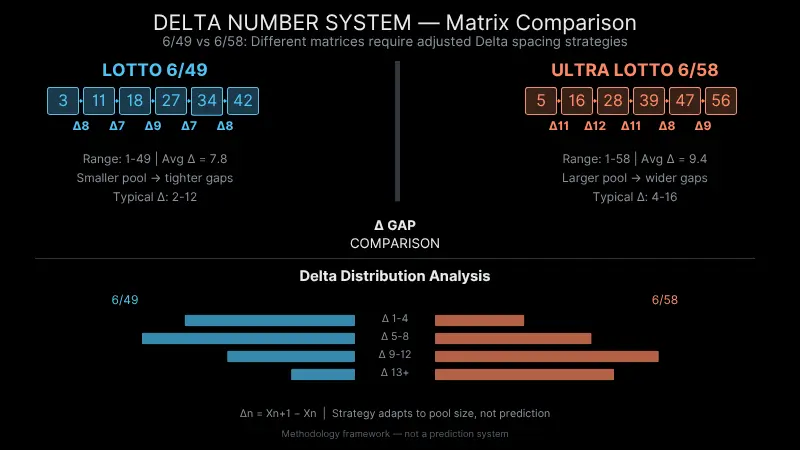
The trickiest part about using the Delta system in the local betting scene is realizing that you cannot use a one-size-fits-all set of numbers. The gaps you choose must match the exact layout of the specific game you are playing.
If you are tracking patterns on a Super Lotto 6/49 grid, your numbers max out at forty-nine, which means your addition chain needs to be relatively tight. A great base sequence here might feature tiny numbers like 1, 3, 3, 5, 7, and 9 to ensure your numbers spread gracefully without overshooting.
When you scale up to the massive Ultra Lotto 6/58 field, everything changes. Because the board stretches all the way to fifty-eight, your numbers need room to breathe. To maintain natural spacing consistency, you must deliberately inject one or two slightly larger gap numbers, such as an 11 or a 14, into your pool.
No matter which game you load on your screen, always run a quick target sum check on your final generated combination. If your converted six-number line adds up to a total that is way too low or incredibly high, your delta intervals were poorly distributed, and you should scramble your gaps again to hit a better pocket.
Spotting the Hidden Patterns: Exploiting Adjacent Pairs’ Frequency
When you analyze how numbers exit the mechanical drawing machines, you will quickly notice that the gaps between numbers are not completely unpredictable or chaotic.
In fact, true tracking data from the PCSO drawing matrix reveals an interesting quirk: consecutive, back-to-back numbers show up far more often than people realize. This occurrence is known as “adjacent pairs frequency,” where two numbers with a delta gap of exactly one—such as 14 and 15, or 32 and 33—land in the exact same winning combination.
If you look closely at local historical frequency charts, you will see that roughly half of all winning draws contain at least one consecutive pair.
This happens because of natural spacing consistency in mechanical systems. When the balls bounce around, they do not distribute themselves in perfectly clean, even intervals across the entire board. By intentionally building a Delta sequence that includes the number 1, you automatically guarantee that your converted ticket will feature a consecutive pair. Integrating this tight interval into your strategy keeps your lines perfectly aligned with the real, proven habits of past winning draws, rather than a theoretical guess.
Hunting the “Delta 1” Trailing Gaps
To spot these clusters before they land on your card, you need to track the trailing gaps across recent drawing history. Open your history feed and calculate the distance between the closest neighboring numbers from the last ten draws.
You are looking for a sudden drop in consecutive appearances—a temporary drought where no adjacent pairs have surfaced for four or five consecutive drawings. Because the long-term data always pulls back toward the historical average, tracking this temporary gap deficit lets you know exactly when to inject a “1” into your next base Delta sequence to catch the correction.
Spotting the Mirror-Gap Echo
Another pattern to watch for on the frequency boards is what seasoned track-splitters call a mirror-gap echo.
This happens when the exact same gap distance appears twice in a single drawing, separated by a wider jump (for example, a winning line of 05, 07, 18, 20, 31, 44 shows two separate Delta-2 gaps: 05 to 07 and 18 to 20).
When a specific interval family (like Delta-2 or Delta-3) starts echoing frequently across multiple weekly draws, it signals an intermediate clustering phase. Spotting these echoes tells you to double down on that specific gap number in your shuffle mix before generating your play slips.
The Easiest Way to Plot Your Converted Delta Sequences Online
Once you have your final six-number combination calculated, it is time to log into your account and lock it in. Using this calculated approach allows you to completely bypass the structural flaws of a standard lucky pick automated engine, which often dishes out highly inefficient number spreads that ignore historical distance habits.

To transition your math smoothly from your scratch paper onto the screen, follow this specific entry process within your digital payslip interface:
1. Open your digital payslip interface
Log into your online betting account and select your target game matrix (such as 6/49 or 6/58). Clear any old selections from the screen to start with a blank card.
2. Perform your final target sum check
Before tapping any buttons, add your six converted numbers together. Ensure the total falls squarely within the high-probability historical sweet spot (typically 115 to 185) to validate your Delta intervals.
3. Plot your primary calculated line
Manually click your six converted numbers onto the digital card layout. Avoid looking at the visual patterns or shapes the numbers make on the grid; trust the distance formula you just ran.
4. Scale your entries with system play permutations
If your entertainment budget allows for multiple lines, take your core Delta pool and shuffle the intervals into a new order. Load these alternative lines into the slip, or select system play permutations to let the interface automatically expand your high-probability coverage across multiple combinations.
Run Your Next Grid Using the Distance-Based Filtering
Stop throwing away your lines on blind guesses or messy, random card spreads. The next time you log into your digital account, leave your lucky numbers behind and build a base Delta sequence instead.
Pick your small gap intervals, shuffle them to mix up the order, and run your cumulative addition chain to generate your lines.
By switching your approach from guessing absolute numbers to tracking historical ball distances, you systematically eliminate low-probability tickets and load your play slip with mathematically balanced combinations before the next big draw.