

If you are looking to branch out from classic poker or local favorites like Tongits, Teen Patti is quickly becoming the ultimate live casino game to watch. Originating from India, this fast-paced three-card game has completely taken off globally, and it is easy to see why local players are jumping on board.
The mechanics are simple to pick up, yet the strategy runs incredibly deep—especially when you are trying to decipher the critical structural differences between a sequence and a colour hand. In this master guide, we will break down the rules, local platform security, and winning card combinations so you can confidently play for real stakes using Philippine pesos.

Understanding the Ante, Boot, and UI Layout
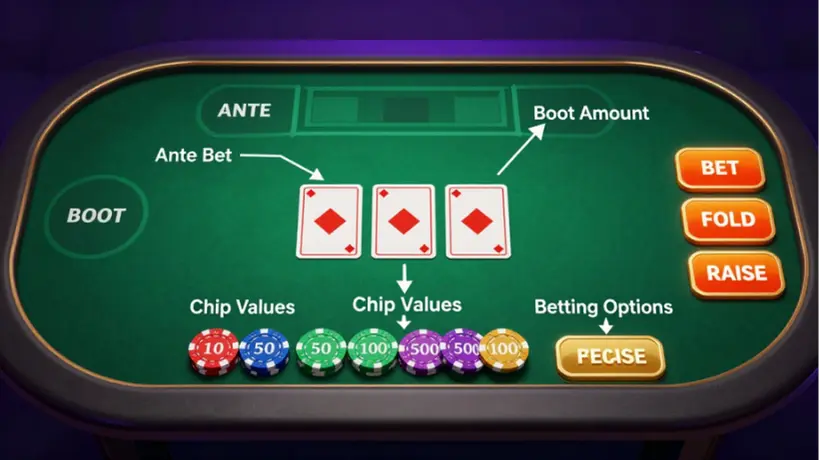
Before the dealer slides any cards across the felt, every round kicks off with the collection of the forced bets.
You will start by placing an ante and bet amount onto the table, which represents the non-negotiable buy-in required to sit in on the hand. This initial chip entry builds the central pot that everyone will be fighting over. Because the pace of play is incredibly brisk, you will rely heavily on the digital interactive UI grid layout on your smartphone or desktop screen.
This touch-responsive interface clearly displays your chip values, active timers, and available betting options, allowing you to react instantly as the live dealer moves the game forward.
As the betting rounds heat up and players begin escalating their stakes, you must keep an eye on the table’s specific Pot Limit Limits. This cap dictates exactly how large the central pool can grow before a mandatory showdown is triggered, preventing any single player from endlessly raising the stakes to price out the rest of the table.
To give you total peace of mind while tracking these fast-growing pots, the underlying software undergoes strict RNG (Random Number Generator) auditing by independent international testing labs. This guarantees that every shuffle, card deal, and numeric payout calculation remains completely unmanipulated, mirroring the authentic randomness of a physical deck.
The Hand Hierarchy: Where Sequence and Colour Stand
To navigate a live round successfully, you need a flawless understanding of the standard three-card hand hierarchy. Because Teen Patti uses a smaller hand size than traditional Texas Hold’em, the mathematical probabilities shift completely, creating a distinct ranking order that might feel a bit upside down if you are coming from Western card games.
The absolute pinnacle of this hierarchy is the trail or set, which consists of three cards of the identical numeric rank—with three aces sitting at the very top of the food chain as the ultimate unbeatable hand.
Here’s the game’s hierarchy (from highest to lowest):
| Hand Name | Description | Relative Strength |
|---|---|---|
| Trail / Set | Three cards of the same rank, e.g., AAA, KKK, QQQ. | Highest |
| Pure Sequence | Three consecutive cards of the same suit (straight flush), e.g., A-2-3 of Hearts. | High |
| Sequence | Three consecutive cards of different suits (straight), e.g., A-K-Q mixed suits. | Average |
| Colour / Flush | Three cards of the same suit but not in sequence, e.g., A-J-8 of Hearts. | Low |
| Pair | Two cards of the same rank, plus one unrelated card. | Lower |
| High Card | No other hand combination. | Lowest |
Right below a set lies the Pure Sequence, which is essentially a straight flush. This powerhouse combination requires three consecutive cards running in perfect numerical order that also belong to the exact same suit.
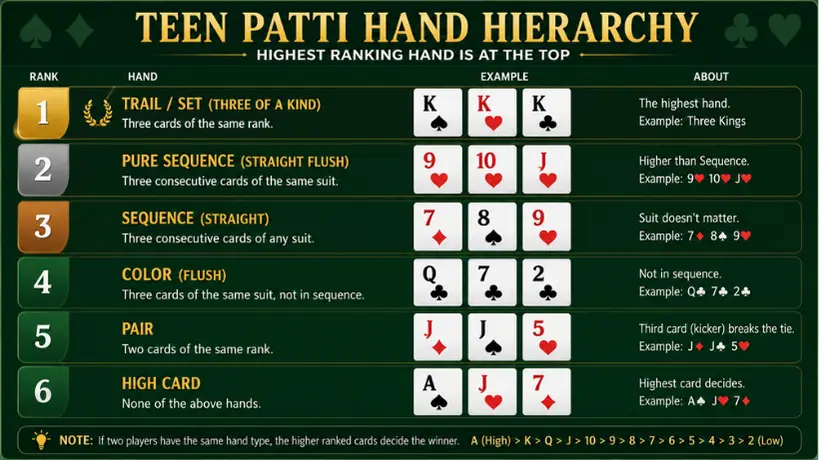
However, the most frequent point of confusion for local players always comes down to the classic showdown of sequence vs. colour. Knowing which of these two combinations beats the other is the absolute line between a winning session and an empty wallet, as a standard run of consecutive ranks holds a distinct statistical advantage over a basic flush.
Deciphering the Sequence: The Power of Consecutive Runs
If you are aiming to lock down a highly competitive position at the table, hitting a standard run is your first major line of defense. When evaluating a sequence vs. colour, a straight sequence consistently beats out a standard flush.
This ranking surprises many poker players, but the math doesn’t lie: in a three-card game, it is statistically harder to pull consecutive numbers than it is to land three random cards of the same suit.
Here’s an example of sequence values, from highest to lowest (mixed suits):
| Sequence Name | Example (Mixed Suits) | Relative Strength |
|---|---|---|
| Highest Sequence | A-K-Q (Mixed Suits) | Highest |
| Mid-Tier Sequence | 9-8-7 (Mixed Suits) | Average |
| Lowest Sequence | 4-3-2 (Mixed Suits) | Lowest |
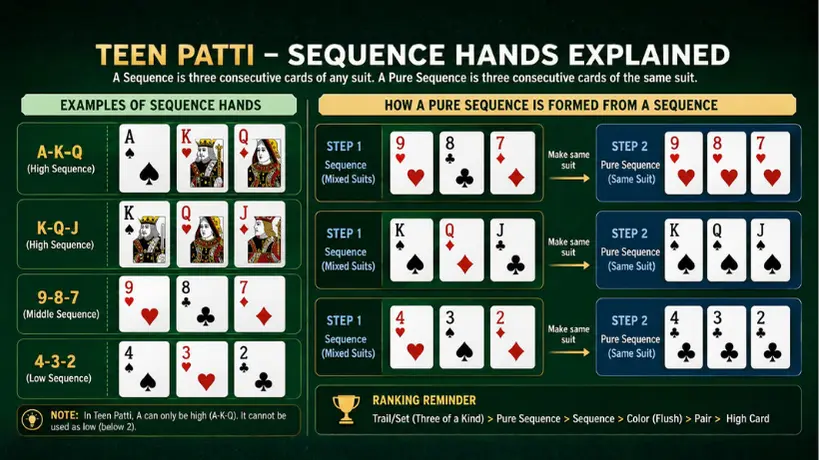
Note:
Wraparounds like K-A-2 are mathematically invalid runs. To fully grasp the three-card hand hierarchy, you have to look at how a standard run operates. A normal run consists of three cards lined up in consecutive numerical order, but they must feature mixed suits. For instance, holding a 4 of spades, a 5 of hearts, and a 6 of clubs forms a valid premium combination. If those identical numbers happen to line up under a single matching suit, your hand instantly upgrades to a pure sequence, which effectively operates as a straight flush and sits directly underneath a royal flush in terms of sheer raw power.
Decoding the Colour: Relying on the Flush Rule
Understanding how a flush functions within this specific three-card ecosystem is vital for protecting your bankroll. In Teen Patti, a flush is universally referred to as a “colour,” and it consists of any three cards that belong to the exact same suit, regardless of their numerical order.
When you find yourself in a tight showdown comparing a sequence vs. colour, it is essential to remember that the colour sits lower on the three-card hand hierarchy than a standard straight run. Because it is mathematically easier to pull three random cards of the same suit from a standard 52-card deck than it is to land three consecutive ranks, a basic colour will always bow down to a mixed-suit straight.
When multiple players at the live dealer table reveal a colour at the exact same moment, the system breaks the tie by analyzing individual card values. The software instantly looks at the highest-ranking card in each hand; for example, an Ace-high colour will easily destroy a King-high colour.
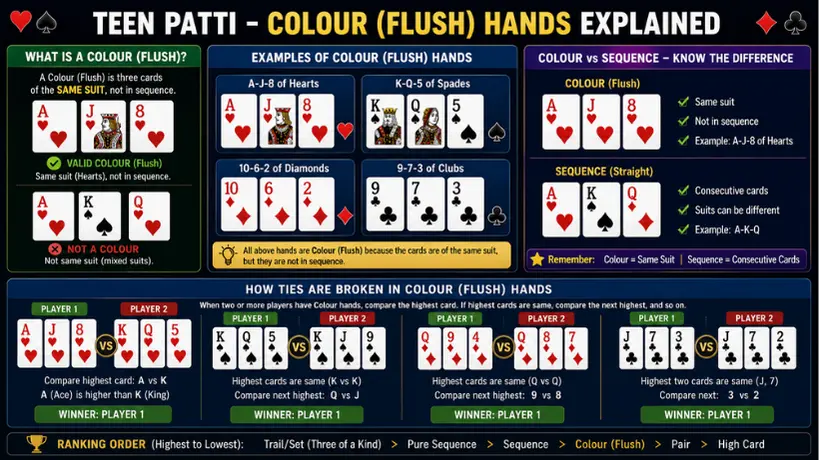
If the highest cards match perfectly, the dealer moves down to compare the second card, and eventually the third card if necessary. In the rare event that all three card ranks are completely identical between both players, the pot is split evenly, as suits hold no individual value superiority in the standard game logic.
Psychology of the Betting Round: Playing Blind vs. Seen
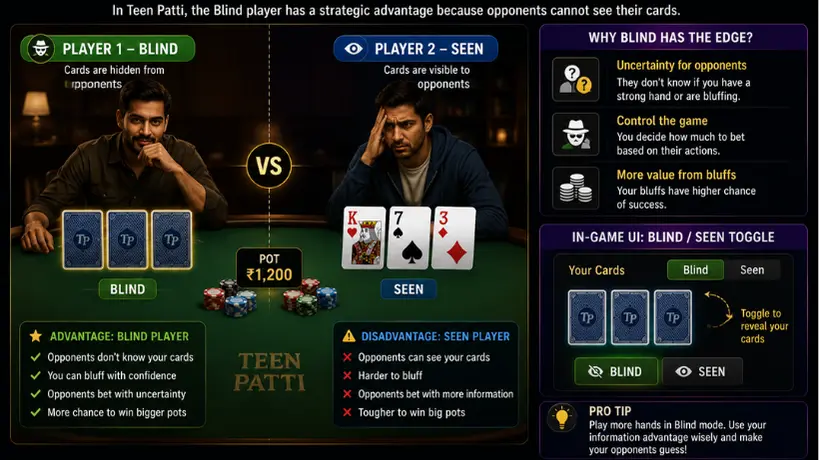
The real psychological battlefield of this game lies in how you manage your visibility at the table. When a new round begins, you face a critical decision: you can choose between playing blind vs. seen. Opting to play blind means you confidently place your wagers without looking at your dealt cards.
This high-risk tactic comes with a massive financial advantage; blind players only have to bet the minimum current stake to stay in the hand, effectively forcing opponents who have already looked at their cards to bet double the amount just to match the pace.
Managing this dynamic requires a sharp eye on the interactive UI grid layout. The digital dashboard features clear, dedicated buttons that allow you to toggle your view or smoothly match the escalating stakes with a single tap.
However, as the psychological pressure mounts and players continuously raise the stakes to push each other out, you must stay hyper-aware of the table’s pot limit limits. Once the cumulative chip pool hits this predetermined ceiling, the system automatically halts all further betting and forces an immediate card showdown, ensuring that the aggressive bluffing of a seasoned player cannot endlessly drain a blind player’s remaining bankroll.
Shifting the Rules: High-Volatility Game Variations
Once you have mastered the foundational confrontation of a sequence versus a flush, you are fully prepared to explore the diverse ecosystem of alternative formats available on digital platforms.
Many premier live hubs shake up the traditional hand structures by introducing specialized gameplay modes that completely flip the standard probabilities on their heads. A prime example of this is the highly entertaining Muflis Mode.
In this low-ball variation, the entire hand ranking system is completely inverted. Your primary objective shifts from hunting down a trail or a pure sequence to intentionally building the weakest three-card combination possible; a miserable high-card hand like a 2-3-5 of mixed suits suddenly becomes the absolute nuts at the showdown, effortlessly crushing an opponent who accidentally lands a premium set of Aces.
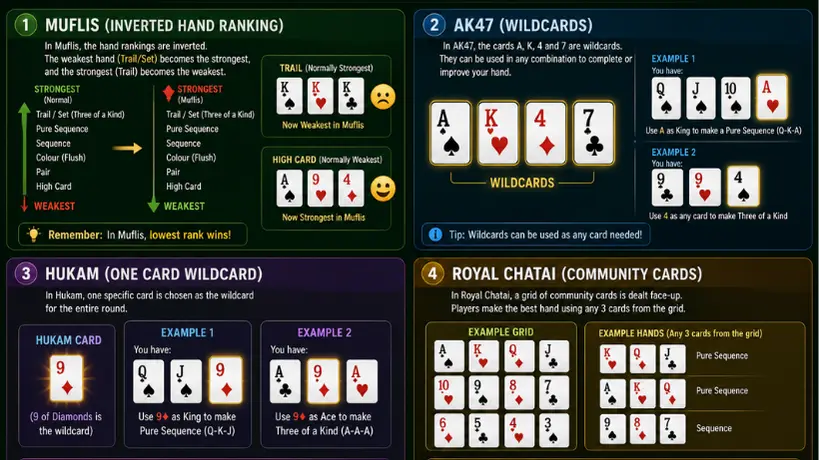
If you prefer games that feature explosive betting rounds and unpredictable twists, the AK47 and Joker variations are right up your alley. In the AK47 format, every single Ace, King, 4, and 7 remaining in the deck acts as a dynamic wildcard, allowing you to substitute its rank and suit to instantly rescue a broken combination and forge a winning run.
Other premium live dealer variations include Hukam and Royal Chatai. Hukam assignments select a specific card rank to serve as the table’s universal wildcard before the round kicks off, while Chatai formats utilize a face-up grid mat layout of cards in the center of the table, forcing you to strategically combine your hole cards with the community grid to manufacture highly complex, multi-card payout structures.
Playing Real Money Teen Patti in the Philippines
Finding a reliable digital table to test your skills requires a bit of local gaming know-how. Your absolute first step before depositing any cash is making sure your chosen platform carries a legitimate license from a PAGCOR-regulated platform.
Playing on platforms like BingoPlus, which are regulated by local authorities, ensures that the software has been audited for fairness and that your hard-earned money is legally protected. Once you log in, you’ll find that top-tier sites offer immersive live streams from Evolution Gaming and Live Studio Feed, bringing professional dealers directly to your screen in real time—making you feel as though you’re in the VIP lounge of a high-end brick-and-mortar casino.

The overall player experience really comes down to how smoothly you can manage your bankroll. The best platforms operating in the market utilize direct GCash / Maya API integration frameworks built right into their cashiers. This means you can fund your wallet or withdraw your winnings instantly in a native Philippine Peso (PHP) balance without losing money to annoying foreign exchange conversions or waiting days for a bank wire to clear.
The entire ecosystem is perfectly built for mobile gaming, giving you the choice to play seamlessly through a standard HTML5 browser vs. a native casino app setup depending on your smartphone configuration.
Claim Your Seat at the Live Teen Patti Tables Today

Ready to put your knowledge of sequence vs. colour to the test? Don’t let the dealer start the next round without you. Click below to register at our top-recommended PAGCOR-regulated platform, fund your account instantly via GCash or Maya, and claim your exclusive 100% welcome bonus in Philippine Pesos.